


Story of Hagia Sophia


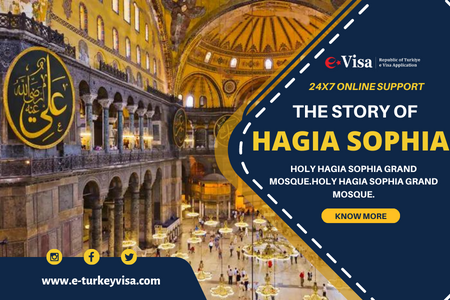
INTRODUCTION
A significant landmark for both the Byzantine and Ottoman Empires is the magnificent Hagia Sophia. The most precious building of its time has always been Hagia Sophia. In the Turkish Republic, it has served as a mosque, a church, and a museum. The ancient metropolis of Istanbul has been home to several civilizations throughout antiquity, the most well-known of which was the Byzantine and Ottoman Empires. The Hagia Sophia, which features both Ottoman and Byzantine elements coexisting beneath a single, enormous dome, is unquestionably a great example of this fusion. The city still demonstrates the characteristics of these two unique civilizations.
This place is as interesting as it sounds and today in this article, we are going to read about the story of Hagia Sophia. This place carries a lot of mysteries and is really interesting at the same time. In order to visit this place, you can visit our website E-Turkey Visa and apply for your Turkey visa.
READ ALSO: FIVE CITIES YOU MUST VISIT WHEN YOU GO TO TURKEY
STORY OF HAGIA SOPHIA
Just like all other historical monuments in the world, Hagia Sophia also has a history but the difference is that this place has a special history! It is always said that Hagia Sophia was never just a monument and was precious in all eras. Let's read Hagia Sophia's history in short:
FROM CHURCH TO MOSQUE
Hagia Sophia (Holy Wisdom, Ayasofya), which was constructed between 532 and 537, is a masterpiece of Byzantine architecture and art. It served as the main church of the Byzantine Empire in its capital, Constantinople (now Istanbul), until being converted into a mosque in 1453 by the Ottoman Empire. The Turkish government decided to turn Ayasofya into a museum in 1934 with the intention of turning it into a reservoir for human history—all of human history, not just a history exclusive to one faith or group of people. This decision was recently overturned, repurposing the structure into a mosque.
MOSQUE TO MUSEUM
Between 1931 and 1949, the Thomas Whittemore founded Byzantine Institute of America tried to find and conserve the Hagia Sophia mosaics. Since taking over the Hagia Sophia project in 1953, Dumbarton Oaks has methodically documented every component of this building, as well as its aesthetic and historical record.
READ ALSO: THE MOST RENOWNED AND SOUGHT THINGS IN TURKEY
FACTS ABOUT HAGIA SOPHIA
AS A CHURCH, IT WAS DESTROYED WICE
The first, wooden-built Hagia Sophia burnt down following a series of riots in 404 CE. Roman Emperor Constantius II dedicated it when it was initially built in Constantinople in 360 CE (son of Constantine, the founder of Constantinople). Emperor Theodosius II ordered the church to be restored in 415 CE, but in 532 CE, when the Nika Revolt wreaked havoc on the city, the chapel was destroyed once again.
THIS CHURCH HAS SEVERAL NAMES
When one learns about the history of Hagia Sophia, this knowledge doesn't seem as startling. The complex was originally referred to as "The Great Church" because of its size. The second church, which was constructed in the fifth century, was given the new name Hagia Sophia, which is Greek for "Holy Wisdom." It was given the new name Ayasofya after the Ottoman invasion. It is also referred to as the Ayasofya Müzesi or the Holy Hagia Sophia Grand Mosque.
THE ORIGINAL DOME WAS DESTROYED IN AN EARTHQUAKE
The Hagia Sophia's imposing central dome was its most prominent feature, standing 160 feet tall and measuring 131 feet in circumference. In 558 CE, an earthquake led to the dome of the Hagia Sophia collapsing. In 562 CE, the walls were strengthened and the structure was reconstructed to a height of 182 feet. Four major arches, arcades, and several smaller domes sustain the weight of the dome.
REMOVAL OF ART PIECES
The state forbade the creation or use of religious images during the iconoclasm era (roughly between 726-787 CE and 815-843 CE), leaving the cross as the sole permissible icon. Numerous mosaics and paintings from the Hagia Sophia were demolished, removed, or covered with plaster.
THE CHURCH BECAME A MOSQUE FOR 500 YEARS
Centuries of sackings, conquests, sieges, invasions, and crusades came to an end with the fall of Constantinople at the hands of the Ottoman Empire in 1453 CE, first under the leadership of Sultan Murad II and then under his successor, Sultan Mehmed II. Mehmed asked for the church's 900-year-old building to be renovated and converted into a mosque after the church was searched for relics and the city was given the new name Istanbul.
READ ALSO: WHAT YOU MUST PACK TO HAVE A WONDERFUL VACATION IN TURKEY
CONCLUSION
This article was about the story of Hagia Sophia and has all the related information about it. There is no doubt that Hagia Sophia is a great place to visit and everyone who visits the city should definitely visit to witness this monument. Hagia Sophia has been a part of a history we can never imagine, even though it is said that the history of this monument is a lot more complicated and deep than it looks. This place has seen so many eras and is absolutely worth visiting.
You can go to our website, E-Turkey Visa, to obtain a Turkey visa. You may find all the necessary information about Turkey and the Turkey E-visa on our website. You may apply at any time by filling out the quick and easy visa application form, which is available around the clock. We provide the best visa services in the market at affordable prices with 24/7 customer support service.
Was this article helpful?
Thanks — that helps us write better guides.


Frequently asked questions
Hagia Sophia, which features a massive 32-meter main dome supported on pendentives (triangular segments of a spherical surface) and two semi-domes, blends a longitudinal basilica with a centrally located structure in a distinctive Byzantine manner.
-
 Tourist Visa
turkey-portal-move-2026-09-23
0 comments
3 views
Tourist Visa
turkey-portal-move-2026-09-23
0 comments
3 views
Best Hiking Trails in Turkey
Do you want to visit the amazing trekking trails of Turkey? Imagine the soul-pleasing scenery you will be… -
 Tourist Visa
turkey-portal-move-2026-09-23
0 comments
5 views
Tourist Visa
turkey-portal-move-2026-09-23
0 comments
5 views
Most Picturesque Locations in Turkey
Are you intrigued by the wonderful and breathtaking scenic sites of Turkey? Turkey has a lot of adventures,… -
 Tourist Visa
turkey-portal-move-2026-09-23
0 comments
4 views
Tourist Visa
turkey-portal-move-2026-09-23
0 comments
4 views
Turkey Visa for Tanzania Nationals
In this article, you can find all the relevant information related to turkey visas for Tanzania nationals.…


Comments
0No comments yet. Be the first to ask a question.